

Multicast Shared Virtual Environments
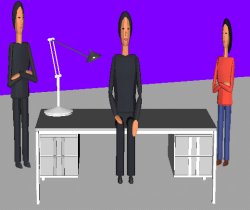
This project was concerned with producing a tool that uses multicast technology to produce shared virtual environments on the Internet. The tool uses Java, VRML and the Mbone, the Internet's multicast backbone, to provide a cross platform system capable of supporting many simultaneous users in a virtual environment.
The project received funding under an initiative of British Telecom and the Joint Information Systems Committee of HEFCE. The research was carried out by John Carson and Graeme Sweeney under the supervision of Adrian Clark. After the project ended, John moved on to work on virtual environments at RSRE (which became Qinetiq). Graeme left Essex for pastures new after the project too but regrettably didn't tell us where he was going.
VRML is already an established standard for distributing 3D environments over the Internet. Browser plug-ins are freely available and the number of Web sites providing 3D content grows daily. The most recent VRML standard provides support for animation, interaction and sound as well as describing scene geometry so allowing rich and detailed environments to be created. At present however, VRML does not provide any support for creating shared virtual environments. In the project we are investigating extensions to the present VRML standard and the necessary wire protocols to allow shared virtual environments to be authored easily and run in VRML 2 capable browsers.
The Living Worlds standard proposed the use of central servers to distribute information to the participants; the same approach is used in most games, of course. The problem is that this server acts as bottleneck and so limits the scaleability of the world. By using the Mbone (Multicast Backbone), which allows a message sent from one machine to be received by many others simultaneously, we aimed dispense with the server and so increase the scaleability of the system.
The approach we took was to develop a multicast interface, written in Java, between the web browser (and it VRML plug-in) and the Mbone. The way it worked was for a participant to visit a website; this cranked up the Java interface and loaded the initial virtual world. All communication between partipants then took place using IP multicasting.
Although we were able to get everything working, we found that it was very fragile, with changes in versions of Netscape or its VRML plug-in causing the software to break. Of course, this was in the fairly early days of the web when browsers were much less solid than they are today.
Screenshots
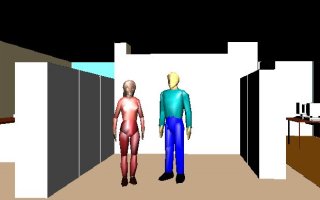
This picture shows two avatars, a barrel chested man and a Lara Croft
look-alike posing in a virtual VASE Lab. Actually there were three
avatars in the virtual world — the pictures you see are from the
viewpoint of the third avatar.
Here you can see Tracey (on the left) and Kevin posing in front of the
Lab's projection screen. Both are hoping for a career in Computer
Games so they're glad of the exposure. Sadly Kevin is rather defective
(you can't it see it in this photo though) — his right arm isn't
quite aligned with this shoulder. This is all John's fault: his hand
slipped on the mouse when he was gluing Kevin arm's on in a modelling
package. John still hasn't forgiven himself.
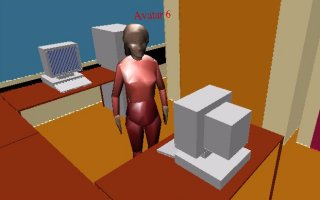
Here's Tracey (or Avatar 6 as she sometimes likes to be known)
standing next to John's computer in the VASE Lab. Note the complete
absence of bits of paper, sandwich packets, books and drink cans in
the surrounding area.
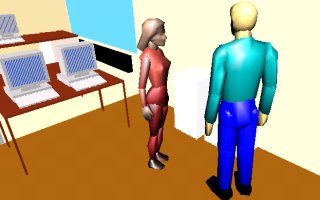
This
is one from the the candid photo collection taken behind the
projection screen where the fridge and servers live. After a hectic
photo session, our two models retire for a cool drink to discuss their
career plans. Kevin is explaining that his audition for a lead in the
latest StreetFighter game didn't go too well — maybe it's due to
that arm injury (ouch). Still, his agent is hoping to get him a bit
part as cannon fodder in the latest Quake clone. Life's hard for
struggling avatars in Cyberspace. Notice the way Tracey stares at the
wall as he talks — perhaps she's trying to tell Kevin something.
If you liked this then do let me know. I might put up the photos from the virtual Christmas party — boy, that ought to make some people blush!